Open vs Closed Models: A Decision Guide
Open and closed AI models have different trade-offs in cost, control, and quality. Learn how to choose the right one for your business.
SquadOS Team · June 9, 2026 · 4 min read
The difference between open and closed models
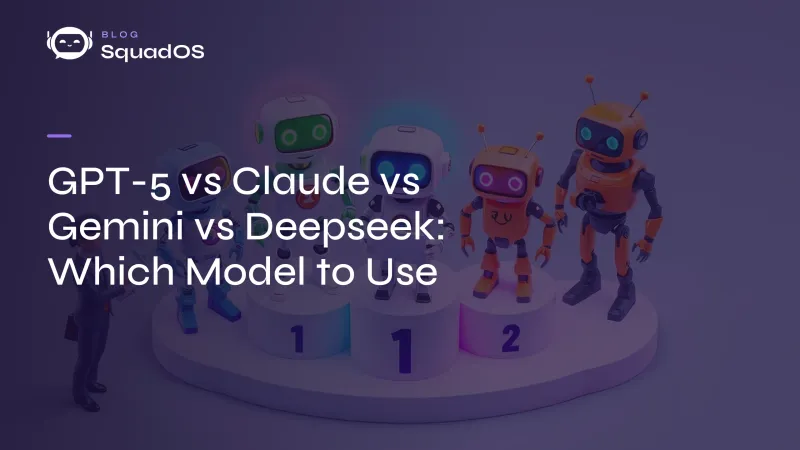
Closed models are those you access via a provider’s API. GPT from OpenAI, Claude from Anthropic, Gemini from Google. You don’t see the code, don’t see the weights, don’t know exactly how it was trained. You pay for usage and accept the terms.
Open models (open weights) are those whose code and weights are public. Llama from Meta, Mistral, Deepseek. You can run them on your own server, modify them, audit them. You don’t pay per token, but you pay for infrastructure.
The choice isn’t “which is better”. It’s “which makes more sense for your case”.
Closed models: when they make sense
You want the best performance without effort. Leading closed models (GPT-4, Claude, Gemini) still lead in complex reasoning, instruction following, and overall quality. If your task demands maximum quality and you don’t want to manage infrastructure, closed is the way.
Your volume is unpredictable. Paying per token means you pay proportional to usage. If one week you use little and the next you use a lot, the closed model scales without you needing to size servers.
You need multimodal out of the box. Closed models generally offer vision, audio, and image generation as part of the API. With open models, you need to build that chain yourself.
Your team is small. Without a dedicated ML engineer or DevOps, running an open model is a headache. Closed arrives ready.
Open models: when they make sense
Cost at scale is a priority. If you process millions of tokens per day, the per-token cost of a closed model becomes a hefty bill. Running an open model on your own or rented GPU is cheaper at volume.
Data control is non-negotiable. If your data cannot leave your environment (healthcare, finance, government), running the model locally is the only option. The open model stays on your server. Zero data leaves.
Customization is needed. You need to fine-tune the model for your domain, add specific behavior, or integrate in ways the closed API doesn’t allow. With an open model, you modify whatever you want.
Vendor lock-in is a concern. If the closed provider changes pricing, discontinues the model, or changes terms, you’re stuck. With an open model, you have alternatives and portability.
Direct comparison
| Criteria | Closed (GPT, Claude, Gemini) | Open (Llama, Mistral, Deepseek) |
|---|---|---|
| Overall quality | Leader | Good to very good (depends on model) |
| Low-volume cost | Low | High (fixed infra) |
| High-volume cost | High | Low |
| Data privacy | Data goes to provider | Data stays in your environment |
| Customization | Limited | Full |
| Maintenance | Zero | Requires infrastructure |
| Multimodal | Ready | Requires assembly |
| Vendor lock-in | High | Low |
The landscape in 2026
The gap between open and closed has narrowed. Models like Deepseek and recent Llama versions deliver quality close to closed models on many tasks.
For standard corporate use (answering questions, summarizing documents, classifying text, generating support responses), a well-configured open model delivers results indistinguishable from closed models in most cases.
The difference shows up in very complex reasoning tasks, high-level creativity, or very long and intricate instructions. There, closed still has the edge.
The hybrid approach: best of both
You don’t need to pick a side. The smartest approach is to use both, switching models based on the task:
- Simple tasks (classification, extraction, summarization): cheap open model.
- Complex tasks (strategic analysis, creative generation, multi-step reasoning): leading closed model.
- Sensitive data: always local open model.
SquadOS offers 30 models from 15 providers in a single platform. You choose the right model for each task and switch at any time, without migration, without reconfiguration. Guardrails and governance are the same for all.
How to decide
Ask your team:
- Can our data leave our environment? If not, local open model.
- What’s the daily token volume? If high, open model saves money. If low, closed is simpler.
- Do we need maximum quality or “good enough”? Maximum = closed. Good enough = open.
- Do we have infrastructure to run models? If not, closed. If yes, open is an option.
In most cases, the answer is “it depends on the task”. And that’s exactly why having access to both in one place makes a difference.
Choose the right model for each task without being locked into one provider: SquadOS offers 30 models from 15 providers, with centralized governance and auditing of every interaction.