AI for Customer Success: How to Reduce Churn and Increase Retention with Agents
Learn how to use AI in Customer Success to identify churn risk, drive proactive onboarding, monitor customer health, and scale support without losing quality.
SquadOS Team · June 18, 2026 · 5 min read
Churn does not happen overnight. The signals show up first.
Customer who stops logging in. Ticket volume that spikes. NPS that drops. Billing email that goes unanswered.
Each signal is a cry for help that nobody heard. Or heard too late.
Traditional Customer Success reacts. The client is already at the exit door when the CSM calls. AI changes that: detects risk before, acts before, resolves before.
Where AI transforms Customer Success
Early churn detection
The biggest value of AI in CS is prediction. Analyzing patterns that humans cannot spot across hundreds of customers.
An agent monitors risk signals in real time:
- Usage drop. Customer who logged in daily and stopped 5 days ago.
- Ticket increase. From 2 per week to 8. Something is wrong.
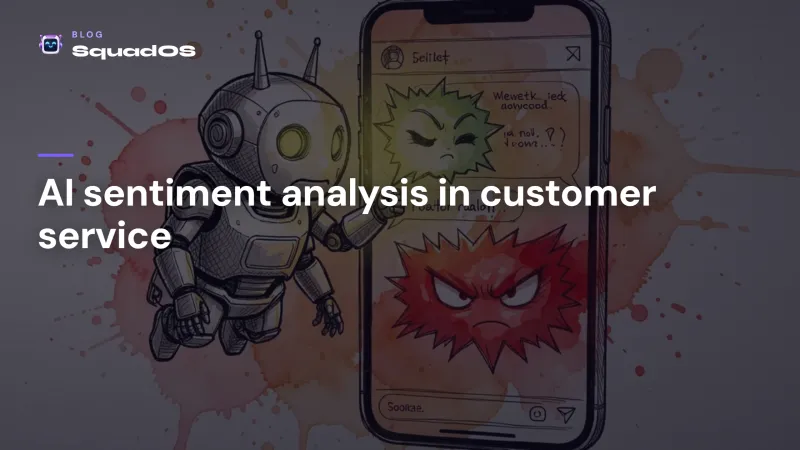
- Negative sentiment. Tone analysis in emails and support conversations.
- Feature not adopted. Customer paying for a feature they never used.
- Contract near expiration. No renewal in progress.
When it detects a combination of signals, the agent alerts the CSM with priority and context: “Customer X has 3 risk signals. Last interaction was 12 days ago. Recommend contacting today.”
It is not guessing. It is pattern matching on real data.
Proactive onboarding
The first 30 days define whether the customer stays or goes. Bad onboarding is the leading cause of early churn.
A CS agent accompanies the new customer:
- Sends a personalized welcome message through their preferred channel.
- Guides step by step through initial setup.
- Detects when the customer gets stuck on a step and offers help.
- Schedules automatic check-ins at 7, 15, and 30 days.
The CSM receives a summary: “Customer Y completed 4 of 6 onboarding steps. Stuck on CRM integration. Suggest calling tomorrow.”
Surgical intervention, not generic.
Customer health monitoring
Health score is not a magic number. It is a combination of usage, satisfaction, support, and engagement.
An agent calculates and updates the score automatically, pulling data from multiple sources:
- Platform usage frequency and depth.
- Ticket history and resolution time.
- NPS and CSAT feedback.
- QBR meeting interactions.
- Payments on time or overdue.
The CSM opens the dashboard and sees: 45 green customers, 12 yellow, 3 red. Knows exactly where to focus.
Fast answers to recurring questions
CSMs spend time answering the same question for different customers. “How do I export the report?” “Where do I configure the integration?” “What is my plan limit?”
A support agent resolves these questions instantly, 24/7, on any channel. The CSM only receives what requires human expertise.
The customer does not wait. The CSM does not repeat themselves. Everyone wins.
Smart expansion and upsell
Customer Success is not just about retention. It is about growing with the customer.
An agent identifies expansion opportunities:
- Customer on basic plan using 90% of quota. Time to suggest upgrade.
- Customer using a feature that has a premium version. Upsell opportunity.
- Growing customer hiring more people. Needs more seats.
The agent does not sell. It signals to the CSM: “Customer Z has upgrade profile. Usage near limit. Suggest Pro plan at next meeting.”
The human conversation closes. The AI pointed to the door.
How to build a Customer Success agent
The structure follows the same pattern: knowledge base, integrations, guardrails.
Knowledge base: onboarding playbooks, escalation policies, product guides, FAQs, success cases, customer health matrix.
Integrations: CRM (HubSpot, Salesforce), product platform (for usage metrics), ticketing system (Zendesk, Intercom), NPS tool, calendar.
Guardrails: the agent should not promise discounts without approval, should not share one customer data with another, and should escalate to a human when it detects serious dissatisfaction.
The CS agent is different from the support agent. Support solves a point problem. CS accompanies the entire journey. The CS agent needs long-term vision, historical context, and the ability to act proactively.
Metrics that matter
Implementing AI in CS without measuring is like driving blind. Track:
- Churn rate. Did it drop after implementation?
- Time to first risk detection. Was it weeks, now is it days?
- NPS and CSAT. Improved with faster responses?
- CSM time on repetitive tasks. Dropped to free up strategic time?
- Expansion revenue. AI-identified upsells that closed?
Numbers tell the story. If the numbers do not move, adjust the agent.
What changes in the operation
Before AI: CSM with 80 customers, not knowing which 5 are at risk, spending 60% of time on repetitive tasks, reacting to churn after it happened.
After AI: same CSM with 80 customers, knowing exactly which 5 need attention today, spending 60% of time on strategic relationship, preventing churn before the red flag.
The difference is not working more. It is working right.
Customer Success with AI is proactive support, early risk detection, and intelligent escalation. SquadOS offers external agents with native guardrails, omnichannel support, and complete audit trails to transform your CS from reactive to proactive.